
5 Simple Steps to Choose Your First Credit Card in India
Learning how to choose first credit card in India options feels like a bigger decision than it actually is. You open a comparison site, see forty cards shouting about lounge access and reward points, and quietly close the tab. Choosing your first credit card in India isn’t about finding the “best” card — it’s about finding the right first card, and the difference matters more than any welcome offer.
Here’s the truth most listicles skip: at this stage, your card is not a rewards machine. It’s a way to start building a credit history. Get that part right, use it well for a year, and every better card in the country opens up to you later. So let’s do this the calm way.
Table of Contents
Why your first card is about credit history, not rewards
When you’ve never borrowed before, banks have no idea whether you repay on time. You’re what they call “new-to-credit” — a blank page. Your first credit card is how you start writing that page.
Every time you pay your bill in full and on time, that behaviour is reported to credit bureaus and slowly builds your CIBIL score (a number between 300 and 900). A healthy score is what later gets you a better card, a lower home loan rate, a bigger limit. Miss payments, and you damage that record before your financial life has properly begun.
So the goal of your first card is simple: pick something easy to get, cheap to hold, and easy to use responsibly. Cashback and points are nice, but they’re the bonus, not the point.
Are you even eligible? The basics
Before comparing cards, know roughly where you stand. Most entry-level cards for salaried applicants look for:
- A monthly income of around ₹15,000–₹25,000 or more (this varies by card and city).
- Age 18+ with a stable, verifiable job.
- Documents ready: PAN card, Aadhaar-linked mobile number, last three months’ salary slips, and recent bank statements.
One quiet tip that improves your odds dramatically: apply where you already bank. If your salary lands in an HDFC, ICICI, Axis, or SBI account, that bank can already see your income and account behaviour, which makes approval far more likely than walking in as a stranger. Check your banking app for any pre-approved offer before you apply anywhere else.
And if you have no credit history at all — or a past hiccup that’s hurt your score — you’re not stuck. A secured credit card, backed by a fixed deposit, is often the smartest first credit card in India for a genuine beginner.. You park an FD with the bank, and your credit limit is usually 80–90% of that amount. Used well for a year, it builds your credit score just like a regular card, and it’s often the smartest first step for a genuine beginner.
How to Choose First Credit Card In India: 5 Things That Matter
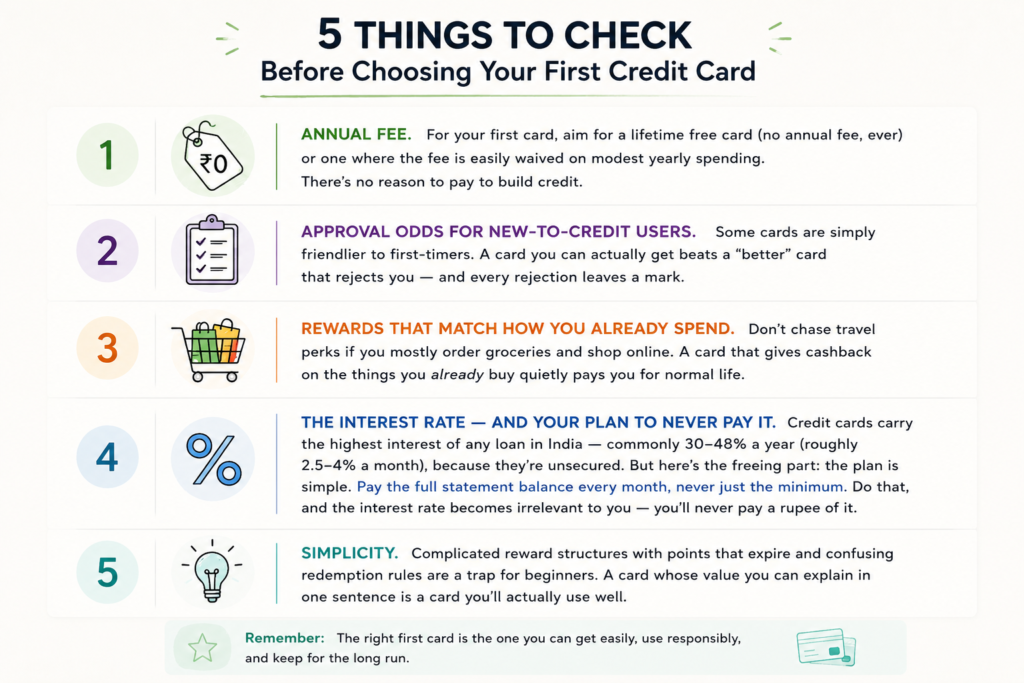
Ignore the noise and judge a first card on these five things, in this order.
1. Annual fee. For your first card, aim for a lifetime free card (no annual fee, ever) or one where the fee is easily waived on modest yearly spending. There’s no reason to pay to build credit.
2. Approval odds for new-to-credit users. Some cards are simply friendlier to first-timers. A card you can actually get beats a “better” card that rejects you — and every rejection leaves a mark.
3. Rewards that match how you already spend. Don’t chase travel perks if you mostly order groceries and shop online. A card that gives cashback on the things you already buy quietly pays you for normal life.
4. The interest rate — and your plan to never pay it. Credit cards carry the highest interest of any loan in India — commonly 30–48% a year (roughly 2.5–4% a month), because they’re unsecured. But here’s the freeing part: the plan is simple. Pay the full statement balance every month, never just the minimum. Do that, and the interest rate becomes irrelevant to you — you’ll never pay a rupee of it.
5. Simplicity. Complicated reward structures with points that expire and confusing redemption rules are a trap for beginners. A card whose value you can explain in one sentence is a card you’ll actually use well.
Beginner mistakes that quietly cost you
Most first-card regret comes from a handful of avoidable errors:
- Applying for several cards at once. Each application creates a “hard inquiry.” Too many in a short window makes banks nervous and can get you rejected. Apply for one, thoughtfully.
- Chasing a premium card too early. That ₹5,000-fee card with the lovely metal finish is not for a first-timer. Start simple; upgrade later from a position of strength.
- Paying only the minimum due. This is how people end up trapped. The minimum keeps the account “current” but lets your balance compound at brutal rates. Pay in full, always.
See it in numbers:
Two people can start with the exact same ₹50,000 balance and end up in completely different places. One clears it in six months. The other is still carrying it years later, having paid back more than double what they borrowed. The only difference between them is how much they pay each month above the minimum.
You don’t need to work this out by hand. Enter your balance, interest rate, and planned monthly payment into our free Credit Card Payoff Calculator, and it’ll show you exactly how many months it’ll take to clear — and precisely how much interest you’ll hand over along the way. Ten seconds tells you whether your current plan is genuinely working, or just keeping you afloat.
Try the Credit Card Payoff Calculator → - Maxing out your limit. Try to use less than 30% of your available limit. High usage, even if you repay it, can weigh on your score.
- Withdrawing cash on the card. Cash advances attract charges and interest from day one, with no grace period. Treat that feature as if it doesn’t exist.
A few solid starter cards to consider
These are widely recommended, beginner-friendly options — not a ranking, just genuinely sensible places to start. As always, check current terms before applying, since features change.
- IDFC First Millennia — one of the most commonly suggested options for a first credit card in India. Lifetime free, reward points that don’t expire, and generally friendly to new-to-credit applicants. A clean, low-pressure entry point.
- SBI SimplyCLICK / SimplySAVE — solid choices if you already bank with SBI, with rewards weighted toward online and everyday spending.
- Axis and HDFC entry-level cards — dependable options, especially if your salary account sits with one of them, thanks to better approval odds and a clear upgrade path within the bank.
The right pick among these comes back to two questions: Where do I already bank? and Where does my money actually go each month? Answer those honestly and the choice narrows itself.
Your first-year checklist
Once your card arrives, the whole game is discipline:
- Use it for regular, planned spending — not new spending you wouldn’t have done anyway.
- Pay 100% of the bill before the due date, every single month.
- Keep usage under 30% of your limit.
- Check your CIBIL score once a quarter (it’s free) and dispute any errors. A score of 750+ opens almost every card; 700–749 is comfortably “good”; and even 650–699 can get you an entry-level card.
- After 12–18 months of clean behaviour, you’ll comfortably qualify for a better card or your first loan.
That’s it. No stress, no cleverness — just a simple card, used well, quietly building the financial reputation that everything else in your money life will one day rest on.
Building your first card is really one piece of a larger picture. If you want to see where it fits, read our companion guide, Financial Freedom for Salaried Indians: A Step-by-Step Roadmap, which lays out the calm, step-by-step path from a steady salary to real financial freedom.

One Comment