

Rent vs Buy a House in India: How to Actually Decide
I’ve sat through this debate of renting vs buying a house, at more dinner tables than I can count – “Rent vs Buy a House in India ” . Someone’s uncle leans back and says “rent is money down the drain.” Someone’s cousin, three years into a home loan, swears by the peace of owning four walls that are finally theirs. Both of them sound completely certain. Neither of them has actually done the math.
That’s the thing about the rent vs buy decision in India — it gets treated like a belief system, not a calculation. Everyone inherits an opinion before they ever run a single number. And after years of looking at money for a living, I’ve come to trust one thing above conviction: the math doesn’t care how strongly you feel about it, or how many relatives agree with you. So let’s actually do the math, in the simplest way I know how, and then leave the final call exactly where it belongs — with you.
Table of Contents

The #1 mistake when deciding to rent vs buy a house in India.
Most people compare two numbers: their monthly rent, and what their EMI would be. If the EMI looks only a little higher than the rent, they assume buying is obviously the smarter move — after all, isn’t rent just “wasted” money?
Here’s the problem with that comparison: rent is only a usage cost. An EMI carries interest, stamp duty, maintenance, property tax, and the opportunity cost of a large down payment sitting inside a house instead of anywhere else. Comparing EMI to rent is like comparing the price of a movie ticket to the total cost of owning a home cinema — one number is doing a lot more work than the other.
The right comparison isn’t “EMI vs Rent” at all. It’s “total wealth after X years” — what you’d actually be left with, on either path, once every cost and every rupee saved is accounted for. That’s a bigger question than most people are willing to sit with, which is exactly why the simpler, wrong comparison wins so many arguments.
The simplest test I know: the 4% rule
Here’s the version I’d explain to a twelve-year-old, because the underlying idea really is that simple.
Take the price of the flat you’re eyeing. Work out 4% of that price for the year — that’s just 4 divided by 100, times the price. Now compare that to what you’d actually pay in rent for a similar flat over a year.
- If your actual rent is lower than that 4% figure, renting is currently the better financial deal — buying that same flat would cost you more than it’s “worth” in rental terms.
- If your actual rent is close to or higher than that 4% figure, buying starts to look more reasonable — you’re not getting much of a discount by renting instead.
That 4% line comes from something called rental yield — simply, how much annual rent a property generates as a percentage of its price. And here’s the quietly important fact almost nobody tells you: in most Indian metros, rental yields sit around 2% to 4%. Property prices have run up faster than rents have. Which means, in a lot of Indian cities right now, the math tilts toward renting more often than the emotional argument admits.
Let’s put real numbers on it
Say you’re looking at a ₹60 lakh flat. A similar flat nearby rents for ₹18,000 a month.
Annual rent = ₹18,000 × 12 = ₹2,16,000 Rental yield = ₹2,16,000 ÷ ₹60,00,000 = 3.6%
That’s below the 4% line — so on pure numbers, renting this particular flat is the better deal right now.
Now here’s where it gets interesting. Say you took an 80% loan on that flat — ₹48 lakh, at 8.5% interest over 20 years. Your EMI comes to roughly ₹41,656 a month. Compare that to the ₹18,000 rent, and the gap is ₹23,656 every single month.
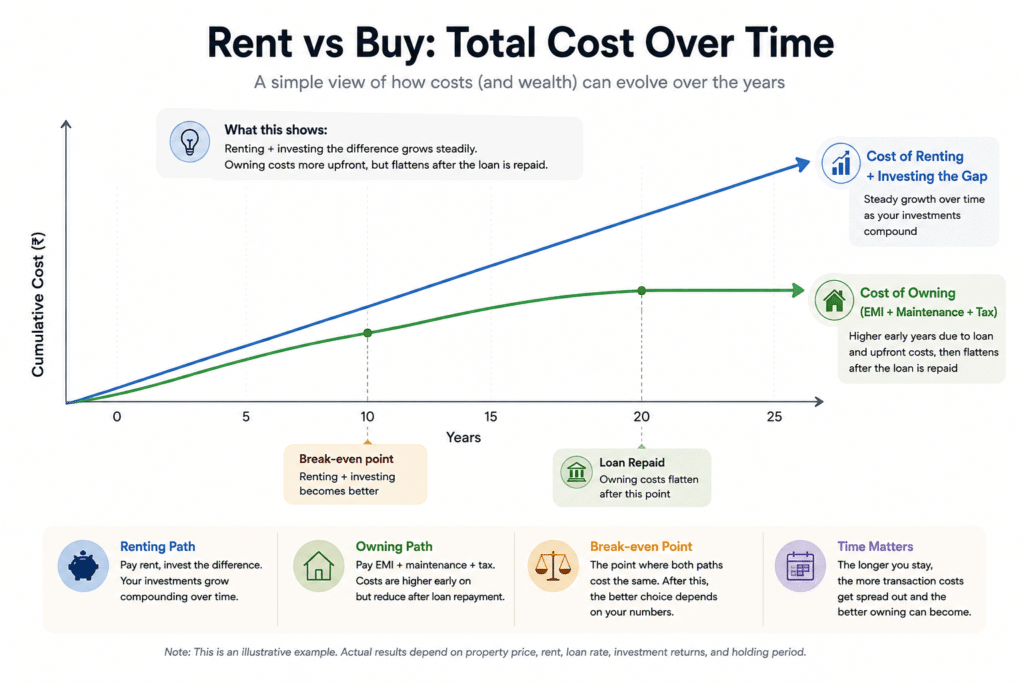
If — and this “if” matters enormously — you actually invested that ₹23,656 gap every month instead of spending it, in something like an equity mutual fund earning a long-term average of 11%, that gap alone would grow to roughly ₹2.07 crore over the same 20 years. That’s not the value of the house. That’s just the side investment, sitting quietly, built from the difference between what you’d pay to rent and what you’d pay to own.
Rent vs Buy a House in India: Cost Comparison Over Time
Why how long you’ll stay changes everything
When looking at the math behind whether to rent vs buy a house in India, transaction costs matter immensely. Here’s a piece of the puzzle the EMI-vs-rent comparison completely ignores: buying and selling a home both cost real money, on top of the price itself. Stamp duty and registration alone typically run 5–7% of the property price when you buy. Add brokerage, interiors, and moving costs, and you can easily spend 8–10% of the property’s value just on the transaction — money that disappears the moment you sign the papers, before the flat has appreciated a single rupee.
This is why the length of time you plan to stay matters more than almost any other factor. If you sell within two or three years, you’re often paying that 8–10% transaction cost twice — once to buy, once to sell — and eating deeply into whatever the property gained in value over that short a window. Stretch that same purchase across ten or fifteen years, and that one-time cost gets spread so thin it barely registers.
Every rent-vs-buy calculation has a “break-even point” — a year beyond which owning starts to genuinely outperform renting. In expensive Indian metros, that break-even point can be surprisingly far out, sometimes well past a decade. In smaller or fast-growing cities, it can arrive much sooner. There’s no single number that applies everywhere; it depends entirely on your city, your price, and your rent.
The honest question to ask yourself isn’t “do I want to own a home someday?” — almost everyone does. It’s “am I confident I’ll still be in this exact city, in a similar life situation, five to seven years from now?” If the answer is a genuine yes, buying’s transaction costs matter much less. If the answer is “I have no idea,” that uncertainty alone is worth taking seriously.
What each side quietly leaves out
Both “sides” of this argument tend to undercount their own real costs, because each one is only telling half its own story. The person who owns a home rarely mentions the maintenance bill or the property tax notice that shows up every year. The person who rents rarely mentions that the money “saved” only builds anything if it’s actually invested rather than spent on something else entirely. Here’s the fuller picture, side by side:
| Buying | Renting | |
|---|---|---|
| Upfront cost | Down payment + stamp duty/registration (5–7%) + brokerage | Usually just a deposit (refundable) |
| Monthly cost | EMI + maintenance (~1%/yr) + property tax (~0.5%/yr) | Rent only |
| Builds equity? | Yes, gradually, as you repay principal | No — but the EMI-rent gap can build wealth instead, if invested |
| Flexibility | Low — selling takes time and money | High — you can move for a job or a life change easily |
| Protected from rent hikes | Yes, EMI is fixed (on a fixed-rate loan) | No — rent typically rises 5–10% a year |
| Tax benefits | Yes — under the old regime, home loan principal (80C) and interest (24b, up to ₹2L) are deductible | None |
| Biggest risk | Overpaying in an expensive micro-market, or needing to sell early | Not actually investing the money you saved by renting |
That last row is the one I’d underline twice. Renting only wins the wealth-building race if the saved money genuinely gets invested — not spent. An EMI is forced discipline. A rent-vs-invest strategy only works if you have that same discipline on your own.
The part that isn’t a spreadsheet at all
Many financial planners agree that the choice to rent vs buy a house in India shouldn’t be emotional. I don’t think this decision is purely financial, and I’d be doing you a disservice pretending it is. Owning a home carries something a rent agreement doesn’t — the freedom to renovate, the sense of roots, not wondering if your landlord will ask you to vacate at the end of an 11-month lease.
Renting carries its own freedom — the ability to move for a better job, a growing family, or simply a life that hasn’t settled into its final shape yet. Neither of those things shows up on a spreadsheet, but both of them are real, and both are allowed to matter to you.
I’d also gently push back on the idea that this has to be an all-or-nothing, forever decision. Plenty of people rent through their twenties and early thirties while they figure out which city, which career, which life they actually want — and buy later, once the picture is clearer, with a much steadier down payment saved up. There’s no prize for buying early just because it feels like the “adult” thing to do.
If you’re planning to stay in the same city for 7+ years, the maths of buying gets steadily more favourable, for the reasons we just walked through. If you genuinely don’t know where you’ll be in three years, renting protects you from locking a decision in before you’re ready to make it.
Where this fits into the bigger picture
If a home loan is part of your plan, it interacts directly with which tax regime suits you — the deductions on principal and interest we mentioned above only apply under the old regime, and a large home loan is often exactly the kind of deduction that tips someone toward it. If you haven’t worked that out yet, our Old vs New Tax Regime guide walks through it calmly, and our Old vs New Tax Regime Calculator will show you the real number for your situation.
And before any of this, it helps to know what you can actually afford to borrow, and what that EMI really looks like month to month. Our free Home Loan Calculator does that math for you in seconds — plug in a property price and see the real EMI, not a guess.
This decision is really just one branch of a bigger tree — the same calm, one-step-at-a-time thinking behind our Salaried Indian’s Roadmap to Financial Freedom.
So — rent, or buy?
I’m not going to tell you. Genuinely — that’s not me dodging the question, it’s the honest answer, and anyone who gives you a confident universal verdict is selling you something or skipping the math themselves. The right choice depends on your city, your price, your rent, and — just as much — on how honestly you can answer questions about your own next few years. But here’s a rough compass, not a verdict:
You might lean toward buying if:
- You’re fairly confident you’ll stay in the same city for 7+ years
- The rent on a similar home is close to or above that 4% yield line
- You’d rather have a fixed, predictable housing cost than one that rises every year
- You know yourself well enough to admit you wouldn’t actually invest the difference if you rented instead
You might lean toward renting if:
- Your next few years are genuinely uncertain — job, city, or life stage
- The flat you’re eyeing has a rental yield clearly below 4%
- You have real investing discipline, and would actually put that EMI-rent gap to work every month
- Flexibility matters more to you right now than putting down roots
There’s no universal right answer here, and there’s no shame in either path — only the answer that’s right for your own numbers, your own next few years, and your own version of sukoon.
