
Penalty for Late Filing of ITR: What It’ll Cost You and What You Can Still Do (AY 2026-27)
I’ll be honest with you — July 31st this year passed the way it always does. Quietly, then suddenly. One moment it’s July and you’re telling yourself you’ll file this weekend, and the next moment it’s August and there’s a small, uncomfortable weight sitting somewhere in your chest.
If that’s where you are right now, take a breath. The penalty for late filing of ITR is real, but it is not the disaster it feels like. The window is still open. The refund you’re owed is still claimable. And the steps to sort this out are simpler than the dread makes them seem.
Let me walk you through exactly what it costs, what most people don’t know about the hidden consequences, and what you need to do before December 31st.
Table of Contents
What Is the Penalty for Late Filing of ITR?
Under Section 234F of the Income Tax Act, the moment you file your return after the due date, the e-filing portal automatically calculates and adds a late fee to your tax computation. There is no officer deciding this, no discretion involved. It is a flat, automatic charge.
Here is what it looks like for AY 2026-27:
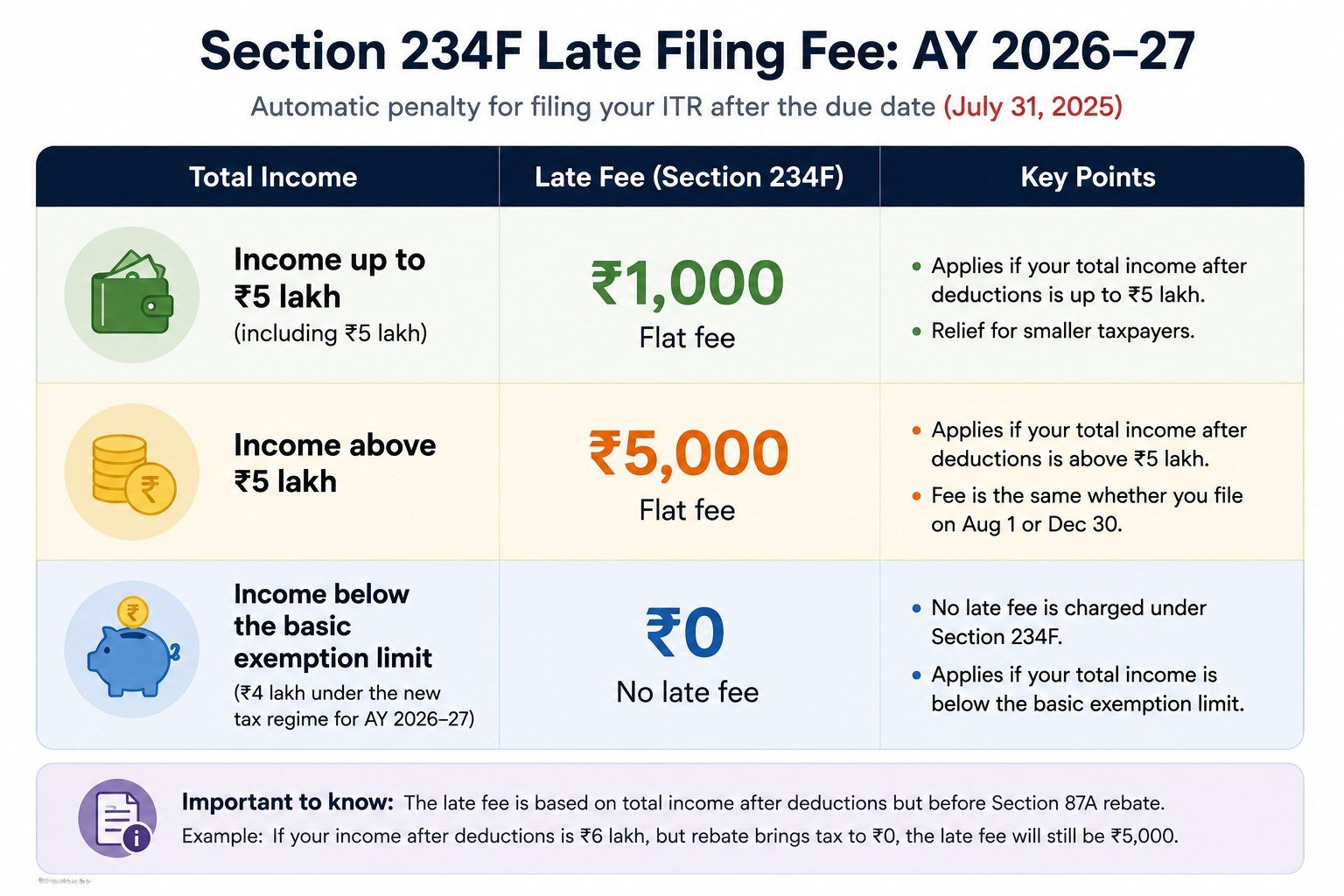
If your total income is above ₹5 lakh: You pay a late fee of ₹5,000. This applies whether you file on August 1st or December 30th — the fee does not increase the longer you wait within this window.
If your total income is up to ₹5 lakh: The fee is capped at ₹1,000. This is a genuine relief provision for smaller taxpayers.
If your income is below the basic exemption limit: No late fee applies at all under Section 234F. Under the new tax regime (which is now the default), the basic exemption limit for AY 2026-27 is ₹4 lakh.
One thing worth knowing: the fee is based on your total income after deductions, before the Section 87A rebate kicks in. So if your income after deductions is ₹6 lakh but the rebate brings your actual tax to zero, Section 234F still charges you ₹5,000 because your income crossed the ₹5 lakh line. This catches a lot of people off guard.
The Hidden Costs Nobody Talks About
The ₹5,000 late fee is the number everyone mentions. But in my view, it is not the most expensive part of filing late. These three consequences hurt more — and they’re rarely explained clearly.
Section 234A interest on unpaid tax If you had any tax payable (beyond what was deducted as TDS) and you’ve filed late, you owe 1% interest per month on that unpaid amount, calculated from August 1st onwards. This runs until the date you actually file and pay. For someone with ₹50,000 in outstanding tax, that’s ₹500 every month — quietly compounding while you delay.
If your tax was fully paid through TDS and you have zero outstanding, Section 234A does not apply to you. But if there’s any gap, sort it immediately.
Loss of carry-forward of losses This one stings the most for people who trade in stocks, run a small business on the side, or have capital losses from investments. To carry forward a loss to the next year — which lets you offset it against future gains — you must file your return on or before the original due date. Filing even one day late means that carry-forward right is permanently gone for that assessment year. Eight years of potential tax offset, lost because of a missed deadline.
No option to switch to the old tax regime If you are a salaried individual who wanted to opt for the old tax regime for AY 2026-27, a belated return locks you into the new regime by default. As we covered in our piece on the [old vs new tax regime], this choice matters significantly if you have home loan interest, HRA, and Section 80C investments stacking up. Filing late takes that choice away.
The Deadline You Actually Need to Know
You have until December 31, 2026 to file your belated return for AY 2026-27 under Section 139(4). After that date, your only option is an Updated Return (ITR-U) under Section 139(8A) — which carries an additional tax of 25% to 50% on top of whatever you already owe. That is a genuinely punishing cost and one worth avoiding entirely.
So the practical message is simple: file before December 31st, even if your documents aren’t perfect. You can revise a belated return until March 31, 2027 if you need to correct something later. What you cannot do is go back and file a proper belated return once that December deadline passes.
Can You Still Claim Your Tax Refund?
Yes — and this is one of the most common questions I hear. Filing late does not forfeit your refund. If TDS was deducted from your salary or interest income and the amount exceeds your actual tax liability, you are entitled to that refund regardless of when you file your belated return.
However, two things to know:
First, the government is not required to pay you interest on the refund amount when you file late. For on-time filers, the department pays 0.5% per month interest if they hold your refund beyond a certain period. Late filers lose this benefit.
Second, the later you file, the longer it takes to process. Refunds for belated returns filed in November or December typically take longer than refunds for returns filed in August. If the refund matters to your cash flow, filing sooner is directly in your interest.
How to Check Your ITR Refund Status
Once you’ve filed, here is how to track where your refund stands:
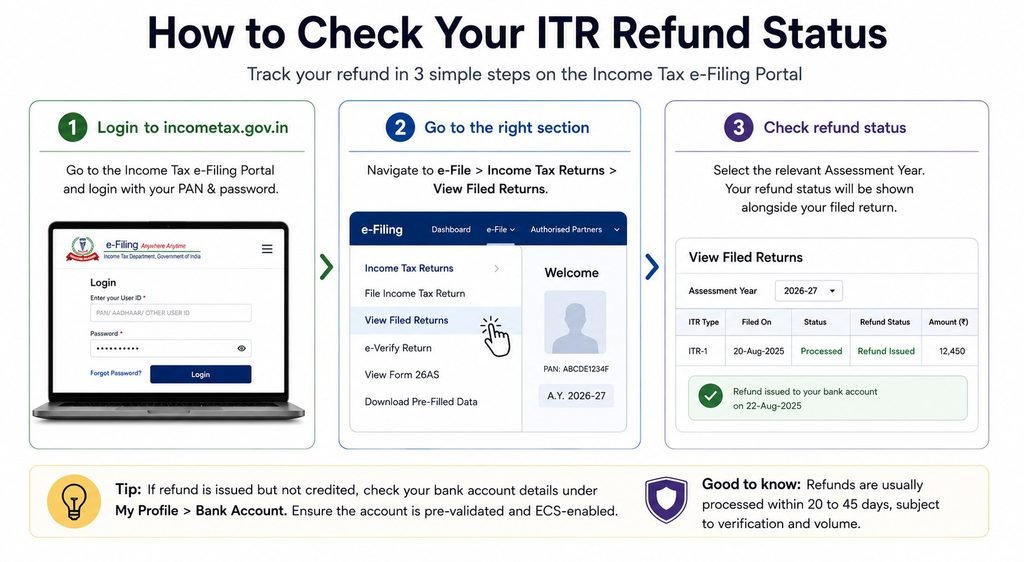
Go to the income tax e-filing portal and log in with your PAN and password. Navigate to e-File → Income Tax Returns → View Filed Returns. Select the relevant assessment year and you’ll see your return’s processing status alongside any refund amount due.
If the refund is shown as issued but hasn’t hit your bank account, it usually means either a bank account validation issue or the account details need updating on the portal. Check under My Profile → Bank Account and ensure the account is pre-validated and ECS-enabled.
Most refunds for properly filed returns process within 20 to 45 days, though it can take longer during peak filing periods.
The Short Version
Missing July 31st is frustrating, but it is not the end of the road. Here is what matters right now:
The penalty for late filing of ITR under Section 234F is ₹5,000 if your income exceeds ₹5 lakh, and ₹1,000 if it’s below — automatically added when you file. If you had unpaid tax, Section 234A adds 1% per month interest on top. Your refund is still claimable. And you have until December 31, 2026 to file your belated return before the much heavier ITR-U cost kicks in.
Stop waiting for the perfect moment. Open the portal, gather your Form 16 and AIS, and file this week. The fee is the same whether you file today or in December — but the peace of mind is very different.
If you are unsure which tax regime applies to your belated return or how your [Section 80C investments] interact with a late filing, those pieces are worth reading before you finalize your return. You may also check the taxable amount in our tax calculator (both under old and new tax regime)