
EPF Form 15G in 2026: It’s Been Replaced to Form 121— Here’s Everything You Need to Know
If you’ve ever withdrawn your PF before completing five years of service, you know the drill — dig out Form 15G, fill it in, hope you’ve done it right, and submit it before TDS gets deducted. It was one of those forms that felt more complicated than it needed to be.
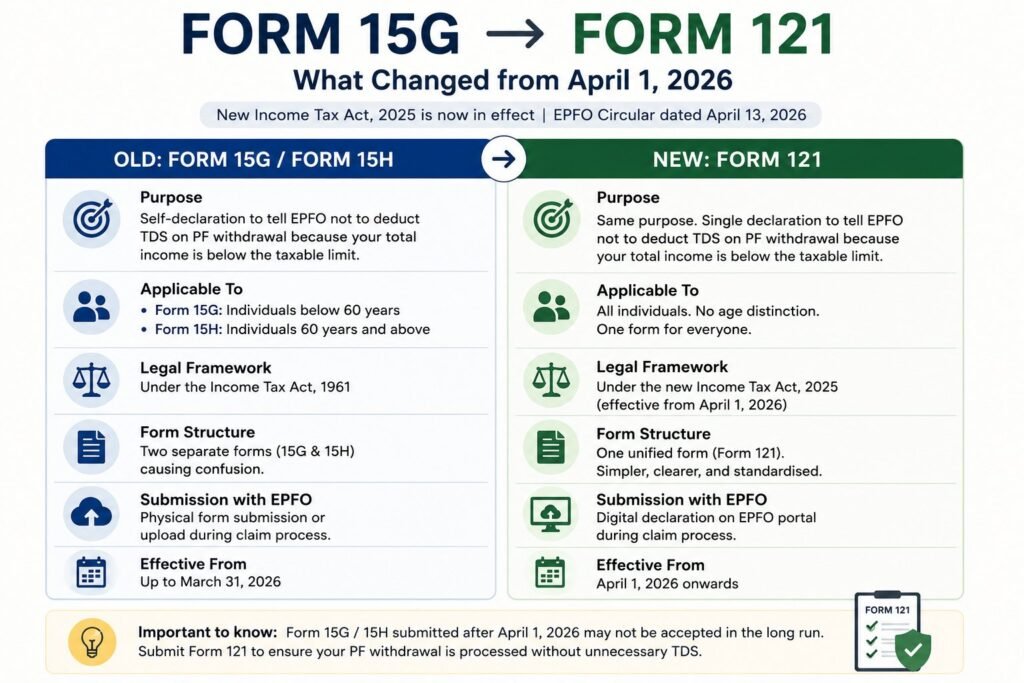
Here’s what most people searching for EPF Form 15G in 2026 don’t know yet: the form no longer exists. As of April 1, 2026, Form 15G and its counterpart Form 15H have been officially replaced by a single unified declaration called Form 121, introduced under the new Income Tax Act, 2025. The purpose is identical — telling EPFO not to deduct TDS because your income is below the taxable limit — but the form, the name, and the process have changed.
This article gives you the complete picture: what changed, whether you actually need to submit it, and how to do it correctly in 2026 without losing money to unnecessary TDS.
Table of Contents
What Was EPF Form 15G — and Why Did It Change?
Form 15G was a self-declaration form under the old Income Tax Act, 1961. When a salaried employee withdrew their EPF balance before completing five continuous years of service, EPFO was required to deduct TDS on the withdrawal amount if it exceeded ₹50,000. Form 15G was how you told EPFO: “My total income this year is below the taxable limit — please don’t deduct TDS.”
The problem was that the system had two forms causing constant confusion. Form 15G was for individuals below 60 years of age. Form 15H was for senior citizens aged 60 and above. People regularly submitted the wrong one, or submitted it to EPFO but forgot their bank, or assumed that one submission covered both their EPF withdrawal and their fixed deposit interest. It didn’t.
When India moved to the new Income Tax Act, 2025, EPFO used the transition to fix this. From April 1, 2026, a single Form 121 — applicable to all ages, all income types, all payers — replaced both. The EPFO circular dated April 13, 2026 made this official.
If you submitted Form 15G after April 1, 2026, EPFO has clarified it won’t be outright rejected immediately — but you will likely need to re-submit using Form 121. Don’t assume the old submission still stands.
Who Actually Needs EPF Form 15G — Form 121 Now — and Who Doesn’t
This is the question most people get wrong, and getting it wrong in either direction costs you. Let me make it very clear.
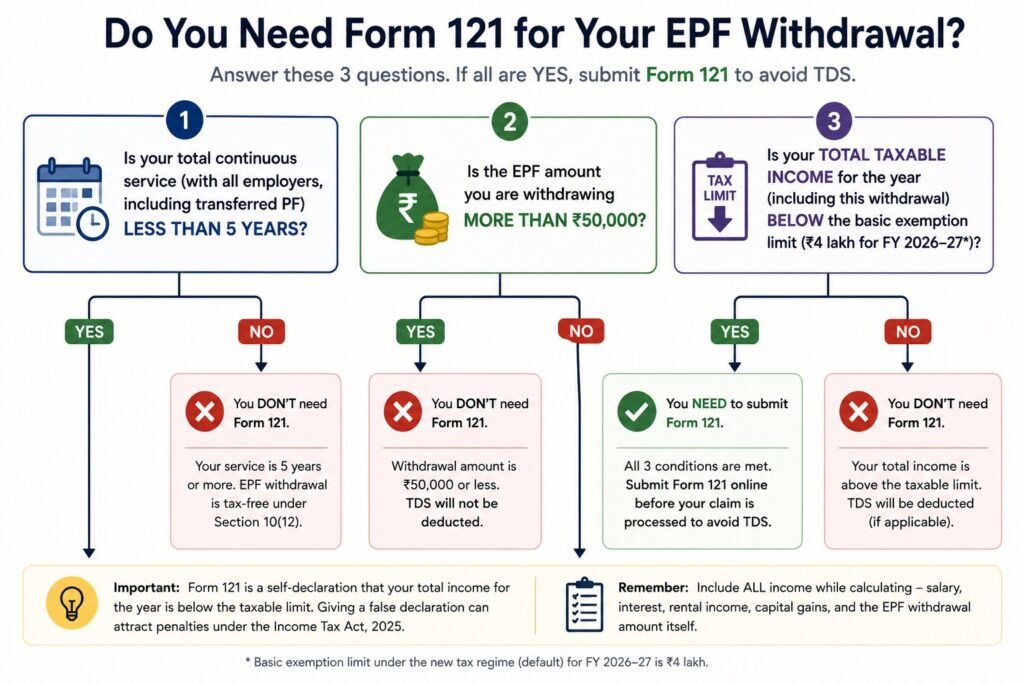
You need to submit Form 121 only if ALL three of these are true:
One — your total continuous service with all employers (combined, including transferred PF) is less than 5 years.
Two — the EPF amount you are withdrawing is more than ₹50,000.
Three — your total taxable income for the year — including this withdrawal, salary, interest, and any other income — is below the basic exemption limit (₹4 lakh under the new tax regime default for FY 2026-27).
If even one of these doesn’t apply to you, Form 121 is not required.
Specifically: if your cumulative service is 5 years or more, your EPF withdrawal is completely tax-free under Section 10(12) of the Income Tax Act. No TDS, no form needed. This is one of the most misunderstood rules in EPF — many employees with long tenures still submit declarations unnecessarily.
And if your total income including the withdrawal crosses the taxable threshold, submitting Form 121 would be an incorrect declaration. In that case, TDS will be deducted and you can claim it back when filing your ITR — but making a false declaration carries penalties under the new Act.
How to Submit Form 121 for EPF Withdrawal — Step by Step
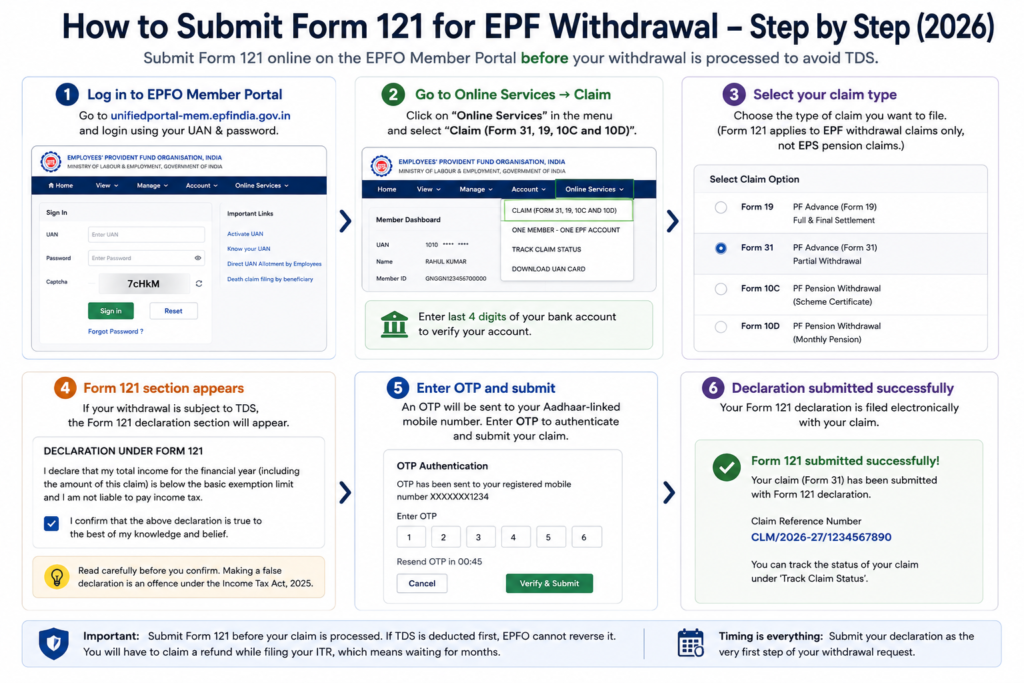
The good news is that EPFO has made the process digital and cleaner than the old Form 15G flow. Here’s exactly how it works in 2026:
Before you start — three things to verify: Your UAN must be active. Your Aadhaar must be seeded and linked to your registered mobile number. Your bank account KYC must be verified on the portal. If any of these are incomplete, sort them first — the portal will block your claim.
Step 1 — Log in to the EPFO Member Portal Go to the EPFO Member Portal and sign in using your UAN and password.
Step 2 — Go to Online Services → Claim Select “Claim (Form 31, 19, 10C and 10D)” from the Online Services menu. Verify your linked bank account by entering the last four digits when prompted.
Step 3 — Select your claim type Choose the appropriate settlement type — full settlement (Form 19), partial withdrawal (Form 31), or pension withdrawal (Form 10C). Note: Form 121 applies to EPF withdrawal claims, not EPS pension claims. Pension has separate TDS rules.
Step 4 — Form 121 section appears automatically If your withdrawal is subject to TDS, the portal will display the Form 121 declaration section. This is where you confirm that your estimated total income for the year — including this withdrawal — is below the taxable limit. Read it carefully before ticking.
Step 5 — Enter the OTP and submit An OTP is sent to your Aadhaar-linked mobile number. Enter it to authenticate and submit. Your declaration is filed electronically alongside your claim — no printing, no physical submission needed.
Critical timing note: Submit Form 121 before your withdrawal request is processed, not after. If TDS is deducted first, EPFO cannot reverse it. Your only recourse at that point is to claim a refund when filing your ITR — which means waiting months for money that should have been yours immediately.
Three Mistakes That Get People Caught
Submitting after the withdrawal starts processing The single most common and expensive mistake. Once EPFO processes the claim, TDS at 10% is deducted automatically if no valid declaration exists. There is no recall. Submit Form 121 as the very first step of your withdrawal, not as an afterthought.
Declaring incorrectly — income higher than exemption limit Form 121 is a legal self-declaration. If your total income for the year — salary, interest, rental income, and the PF withdrawal itself — exceeds the basic exemption limit, you are not eligible. Many people calculate only their salary and forget to include the withdrawal amount itself in their estimated income. Include everything.
PAN not seeded with EPFO If your PAN is not linked to your UAN, EPFO deducts TDS at 20% instead of 10% — regardless of whether you’ve submitted Form 121. Check your KYC status on the portal under Profile → KYC before initiating any withdrawal.
The Short Version
EPF Form 15G is no longer the form you need. From April 1, 2026, it’s been replaced by Form 121 under the new Income Tax Act, 2025 — a single, unified declaration for all ages and all payers. The purpose hasn’t changed: it tells EPFO not to deduct TDS on your PF withdrawal because your total income is below the taxable limit.
You need it only if your service is under 5 years, withdrawal exceeds ₹50,000, and your total annual income stays below the exemption limit. If all three apply, submit it on the EPFO portal before your claim is processed — not after.
If your service is 5 years or more, your withdrawal is tax-free and no declaration is needed at all. That’s the rule most people don’t know — and knowing it saves both time and unnecessary paperwork.






One Comment