

Atal Pension Yojana (APY Scheme): Complete Guide to Eligibility, Contribution Chart & Benefits in 2026

Table of Contents
Before we dive into the APY scheme details — ask any salaried professional about retirement planning and they’ll mention an EPF account, maybe an NPS contribution, perhaps a mutual fund SIP. Ask a daily-wage earner, a street vendor, or a domestic worker the same question, and there’s often silence. No employer pension, no provident fund, nothing guaranteed after 60.
The Atal Pension Yojana (APY) was built specifically to close this gap. It is a government-backed pension scheme that gives millions of unorganised-sector workers something they never had before — a guaranteed, fixed monthly pension after retirement, with no market risk involved.
But here’s something most salaried readers need to know upfront, and I’ll be straight about it: if you’re an income-tax payer, you cannot join the Atal Pension Yojana scheme. This rule has been in effect since October 2022. So before you go further, know whether this article is for you, your parents, your household help, or someone in your extended family who fits the target profile.
Let’s get into exactly what the APY scheme actually offers, who it’s really for, and everything you need to know about eligibility, contribution, and claims.
What Is Atal Pension Yojana (APY)? — APY Scheme Explained
Atal Pension Yojana is a government-backed pension scheme, regulated by the Pension Fund Regulatory and Development Authority (PFRDA), that provides a guaranteed monthly pension of ₹1,000 to ₹5,000 starting at age 60. Launched in June 2015, the APY scheme (Atal Pension Yojana) was designed for workers in India’s unorganised sector — people without access to an employer-sponsored pension or provident fund.
The APY full form is Atal Pension Yojana, named after former Prime Minister Atal Bihari Vajpayee. It sits under the same Jan Suraksha umbrella as PMSBY and PMJJBY, but unlike those two insurance schemes, APY is a pension/savings scheme — you contribute regularly during your working years, and the government guarantees a fixed pension payout once you turn 60.
Unlike NPS (National Pension System), where your final payout depends on market performance, the APY scheme offers certainty: you choose your pension amount at enrolment, and the government tops up the corpus from its own resources if investment returns fall short of the guaranteed amount.
As of 2026, the APY scheme has crossed 9 crore total subscribers under this pension scheme, with the 2025–26 financial year recording its highest-ever enrolment — over 1.35 crore new subscribers in a single year.

APY Scheme Details — Who Administers the APY Scheme and How It Works
The APY scheme is regulated and administered by PFRDA (Pension Fund Regulatory and Development Authority) and operationally supported by Protean CRA (formerly NSDL), which manages your PRAN (Permanent Retirement Account Number) and account records.
APY PRAN stands for Atal Pension Yojana Permanent Retirement Account Number — a unique account number generated for every subscriber, similar to how NPS accounts work. Your APY account is entirely separate from any NPS account you may hold; the two are not mutually exclusive, and a person can maintain both.
Key structural facts about how the APY scheme works:
- One APY account per person — you cannot hold multiple APY accounts
- Bank or post office savings account is mandatory — contributions are collected via auto-debit
- APY account is Aadhaar and mobile-linked
- Contribution frequency options: monthly, quarterly, or half-yearly — your choice at enrolment
- The pension amount is fixed at enrolment and does not fluctuate with market conditions
Who Is Eligible for the APY Scheme? — APY Scheme Eligibility Criteria
Eligibility for the APY scheme is based on age, and — critically — tax status.
Core eligibility criteria for the APY scheme:
- Age: 18 to 40 years at the time of joining
- Bank account: A savings account at a bank or post office, linked to Aadhaar and mobile number
- Not an income-tax payer — this is the rule that changed everything
⚠️ The rule most people miss about APY scheme eligibility: income-tax payers cannot join. Effective 1 October 2022, the Government of India excluded income-tax payers from enrolling in the Atal Pension Yojana scheme. If you have ever filed income tax as a taxpayer (not just filed a return with nil tax), you are not eligible to open a new APY account. This rule remains firmly in place in 2026.
What this means practically for Sukoon Money readers: many salaried professionals reading this — especially those in higher income brackets who pay tax — will find they cannot enrol in the APY scheme themselves. This scheme is genuinely designed for the unorganised sector: domestic workers, street vendors, gig workers, daily-wage earners, small shop owners, and anyone without a formal employer pension who also falls below the income-tax threshold.
If this doesn’t apply to you directly, it may apply to household staff, family members, or people in your circle who would genuinely benefit from telling them about it.
APY Scheme Contribution Chart — How Much to Invest by Age
This is the most searched detail about the APY scheme, and for good reason — the APY scheme contribution depends heavily on age — the contribution amount depends heavily on the age at which you join.
The core principle: the earlier you join, the lower your monthly contribution for the same guaranteed pension.
APY scheme contribution chart by age:
Key contribution details:
- You choose one of five guaranteed pension levels: ₹1,000, ₹2,000, ₹3,000, ₹4,000, or ₹5,000 per month
- Contributions can be monthly, quarterly, or half-yearly — quarterly and half-yearly amounts are simple multiples (3x and 6x the monthly figure)
- You can increase or decrease your chosen pension amount once a year, typically during the month of April
- Contributions are collected via auto-debit from your linked bank account until you turn 60
APY Scheme Benefits — What Does It Actually Give You?
The core benefit of the APY scheme is straightforward: a guaranteed, government-backed monthly pension for life, starting at age 60.
Key benefits of the APY scheme in 2026:
- Guaranteed pension amount — fixed at enrolment, unaffected by market performance
- Government top-up guarantee — if actual investment returns fall short, the government funds the shortfall to ensure you receive your chosen pension amount
- Low entry cost — starting contributions can be as low as ₹42/month for the lowest pension slab at the youngest entry age
- Spousal continuation — if the subscriber passes away, the spouse can continue receiving the same pension amount, or continue contributing to the account
- Nominee payout — if both subscriber and spouse pass away, the nominee receives the accumulated corpus in the account
APY Scheme Death Claim — What Happens If the Subscriber Passes Away?
Understanding the APY scheme’s death claim process matters for every subscriber’s family.
In case of the subscriber’s death before age 60:
- The spouse is the default nominee and can choose to either receive the same pension the subscriber was entitled to, or continue contributing to the account until the original vesting age
In case of the subscriber’s death after age 60 (during the pension payout phase):
- The spouse continues to receive the same pension amount for their lifetime
- On the death of both subscriber and spouse, the nominee receives the total accumulated pension corpus as a lump sum
The APY scheme death claim amount, therefore, depends on when the death occurs — whether during the contribution/accumulation phase or after pension payouts have begun.
How to Apply for the APY Scheme Online
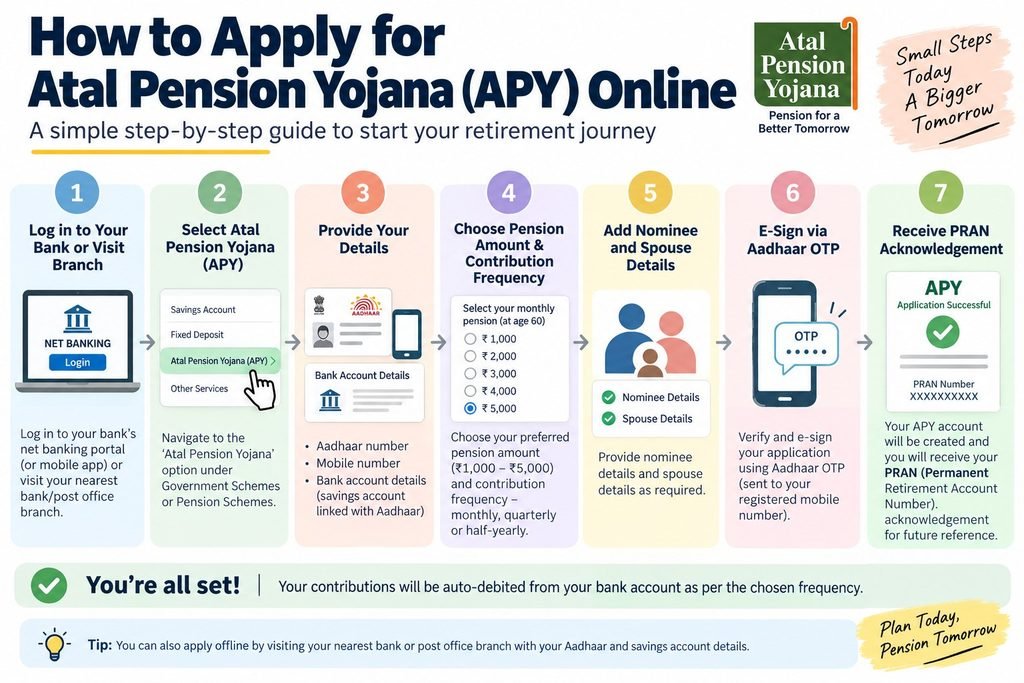
Applying for the APY scheme can be done online or offline — here’s the full APY scheme application process:
Online — via net banking:
- Log in to your bank’s net banking or mobile app
- Navigate to Atal Pension Yojana / APY under government schemes
- Enter your Aadhaar number, mobile number, and bank account details
- Select your desired pension amount (₹1,000 to ₹5,000) and contribution frequency
- Provide nominee and spouse details
- E-sign using Aadhaar-based OTP authentication
- Your PRAN (Permanent Retirement Account Number) will be generated and shared
Offline — via bank branch or post office:
- Visit the bank branch or post office where you hold a savings account
- Request the APY registration form
- Fill in the form and attach a photocopy of your Aadhaar card
- Submit to the bank official
- Collect the acknowledgement slip containing your PRAN
How to Check Your APY Scheme Statement and Balance Online
Once your APY scheme account is active, checking your account statement is simple.
Via NSDL/Protean CRA (if your APY account is registered there):
- Visit the official Protean CRA / NSDL e-Governance website
- Enter your PRAN
- Provide your registered bank account number and date of birth for verification
- View or download your APY account statement showing contribution history and current balance
Via your bank’s net banking or mobile app: Most banks display your APY contribution history and account balance directly under the Government Schemes or Investments section.
Via email: You can also opt to receive periodic APY account statements directly to your registered email address.
How to Close or Exit the APY Scheme Before or At 60
Exiting the APY scheme before age 60 is possible only under specific circumstances:
- Voluntary exit from the APY scheme before 60: Permitted only in exceptional cases (such as terminal illness), and you receive only your own contributions along with the actual returns earned — no government co-contribution or guarantee applies to premature exits
- On reaching age 60: You submit a request to your bank to begin receiving your pension. At this point, you may also choose a one-time lump-sum withdrawal of your accumulated corpus alongside starting the monthly pension
- Missed contributions/default: If you miss contributions, a penalty is charged and added to subsequent payments. Continued default beyond a certain period can lead to account freezing or closure — check with your bank on reactivation steps if this happens
APY Scheme vs NPS — Which Should You Choose?
Since both are pension schemes regulated by PFRDA, people often confuse the APY scheme with the National Pension System (NPS). Here’s the difference:
Bottom line: the APY scheme is about certainty for those who need a guaranteed floor. NPS is about growth potential for those comfortable with market-linked returns — and it’s the scheme most salaried, tax-paying Sukoon Money readers should actually be looking at instead.
Should You (or Your Family) Join the APY Scheme in 2026? — The Sukoon Take
If you’re a salaried, tax-paying professional reading this, the honest answer is: the APY scheme is not built for you. You’re better served by NPS, EPF, and a well-structured mutual fund SIP portfolio for retirement planning.
But the APY scheme remains one of the most quietly impactful government schemes in India for the people who genuinely need it — a domestic help who works multiple households, a delivery gig worker, a small vendor, a parent or relative without a formal pension plan. For them, the Atal Pension Yojana scheme offers something genuinely rare: a guaranteed, inflation-resistant floor income after 60, backed by the Government of India, for a monthly contribution smaller than a mobile recharge.
If you know someone in this category, helping them understand and enrol in the APY scheme could be one of the most meaningful pieces of financial guidance you give this year.
Have questions about Atal Pension Yojana or want help understanding NPS instead? Drop them in the comments.
Also read: