

Section 80C Investments in 2026: Do They Still Make Sense for Salaried Indians?
In our last piece, we walked through the old vs new tax regime decision — that one choice that sits quietly on your to-do list every April and somehow still feels unresolved by July. If you came out of that article having decided to stick with the old regime, or if you’re still weighing both sides, there’s a natural next question: what about Section 80C? Does it even matter anymore?
You may have seen headlines saying “80C is dead” or “Section 80C no longer exists.” That deserves a calm, straight answer. Section 80C investments in 2026 are very much alive — but whether they’re worth your attention depends entirely on one thing: which tax regime you’re in.
Let’s sort this out simply.
Table of Contents
What Actually Changed — and What Didn’t
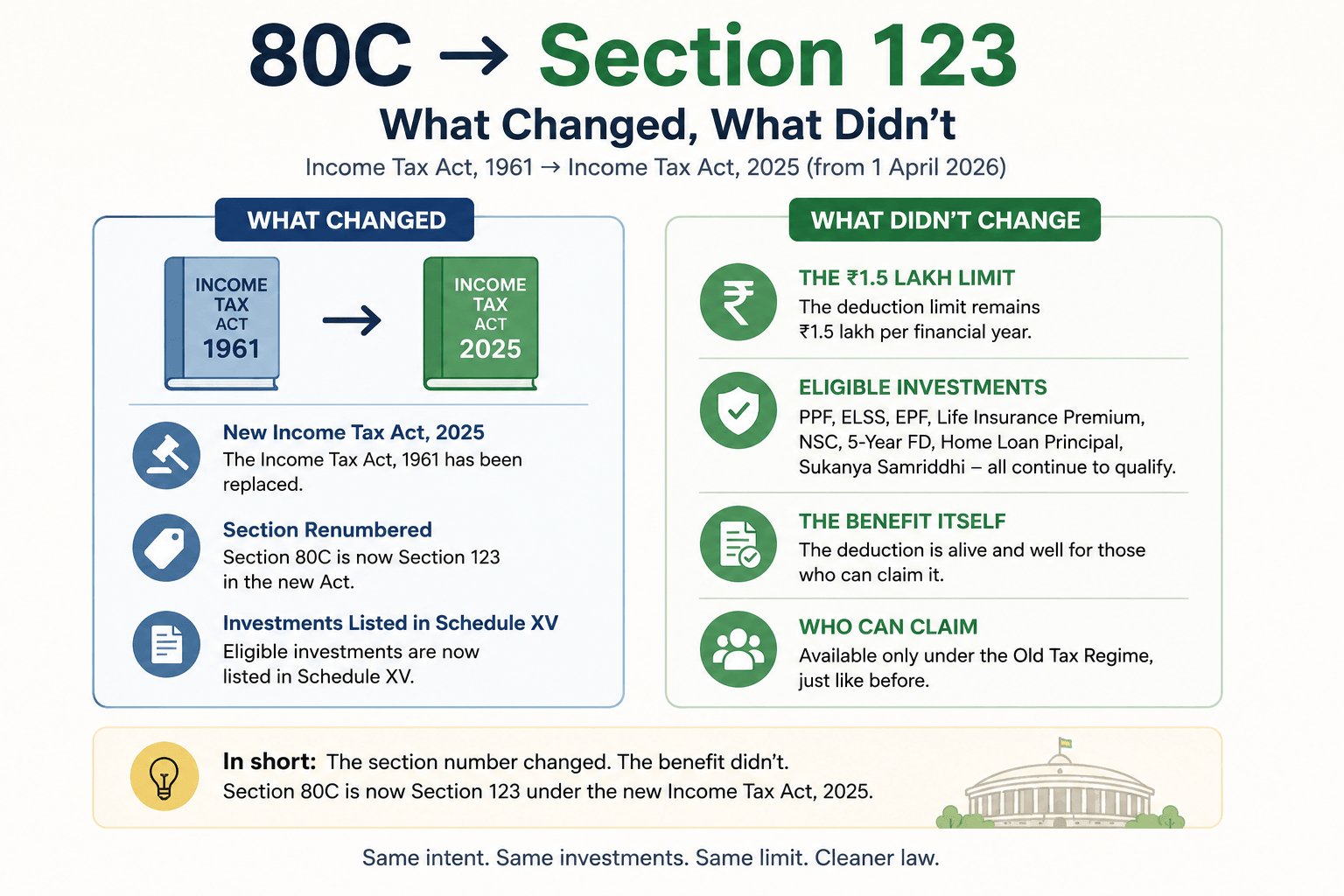
From 1 April 2026, India moved to the new Income Tax Act, 2025. This replaced the Income Tax Act, 1961, which had governed our taxes for over six decades. As part of this shift, all the familiar section numbers got renumbered.
Section 80C became Section 123, with the eligible investments now listed in Schedule XV of the new Act.
That’s it. The section number changed. The ₹1.5 lakh deduction limit stayed exactly the same. The investments that qualified before — PPF, ELSS, EPF, life insurance premiums, NSC, term deposits, home loan principal, Sukanya Samriddhi — all continue to qualify. Nothing was removed, nothing was added. The government simply tidied up decades of amendments into a cleaner structure.
So when someone tells you “80C is dead,” what they really mean is: the old section number no longer exists in the new Act. The benefit itself is alive and well — for those who can claim it.
The Catch: It Only Works in the Old Tax Regime
Here is where things actually matter for your wallet.
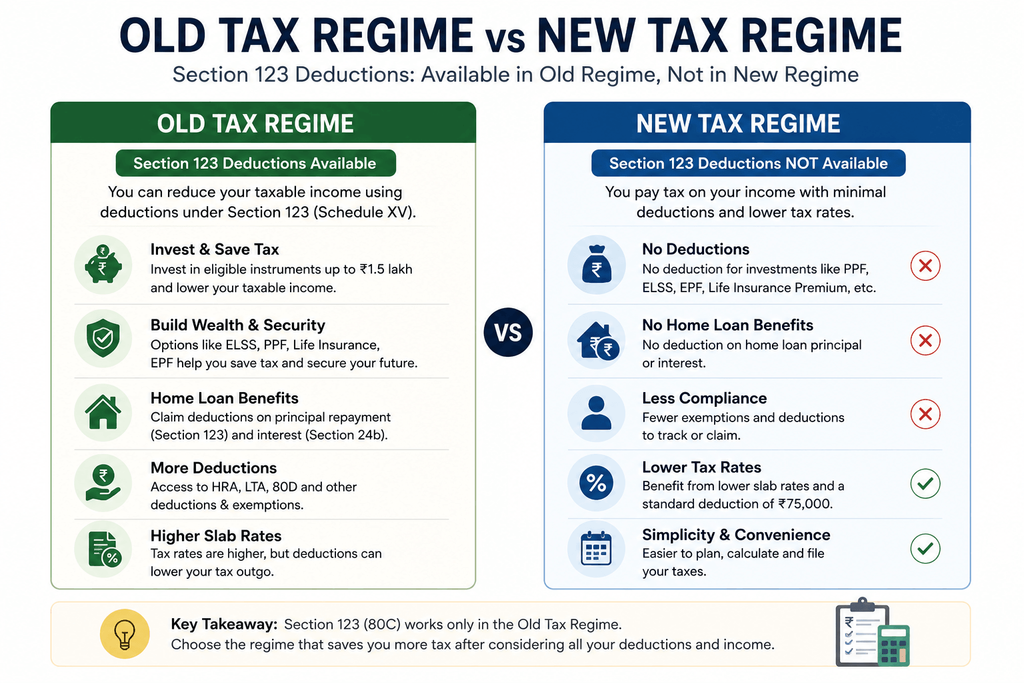
Section 123 (the new 80C) is available only if you opt for the old tax regime. Under the new regime — which has been the default since FY 2023-24 — you cannot claim this deduction at all. You get a flat ₹75,000 standard deduction and lower slab rates, but the old deduction categories like PPF, ELSS, and insurance premiums don’t reduce your taxable income.
This is the real question for 2026: not whether 80C exists, but whether the old regime — and therefore your 80C investments — is saving you more than the new regime’s simpler, lower rates would.
A quick way to think about it:
- If your total Section 123-eligible deductions (EPF already counted + any active investments) exceed roughly ₹3–3.5 lakh, the old regime is worth serious consideration at income levels of ₹10–15 lakh.
- If you’re at ₹12.75 lakh salary or below and have no home loan or HRA, the new regime is almost certainly giving you zero tax with much less effort.
- If you have both a home loan (principal + interest) and active 80C investments and HRA — the old regime math can still work significantly in your favour.
There’s no single right answer. But it’s always a calculation, not a feeling.
Which Section 80C Investments in 2026 Still Make Sense?
If you’ve decided the old regime is right for you, here are the instruments under Schedule XV worth considering — matched to what they’re actually good for, not just their tax label.
EPF (Employee Provident Fund) If you’re salaried, your EPF contribution is already happening automatically. It counts toward your ₹1.5 lakh limit. Most salaried employees at ₹6–8 lakh+ annual income have already used ₹30,000–₹60,000 of their limit just through mandatory EPF before making a single active investment decision.
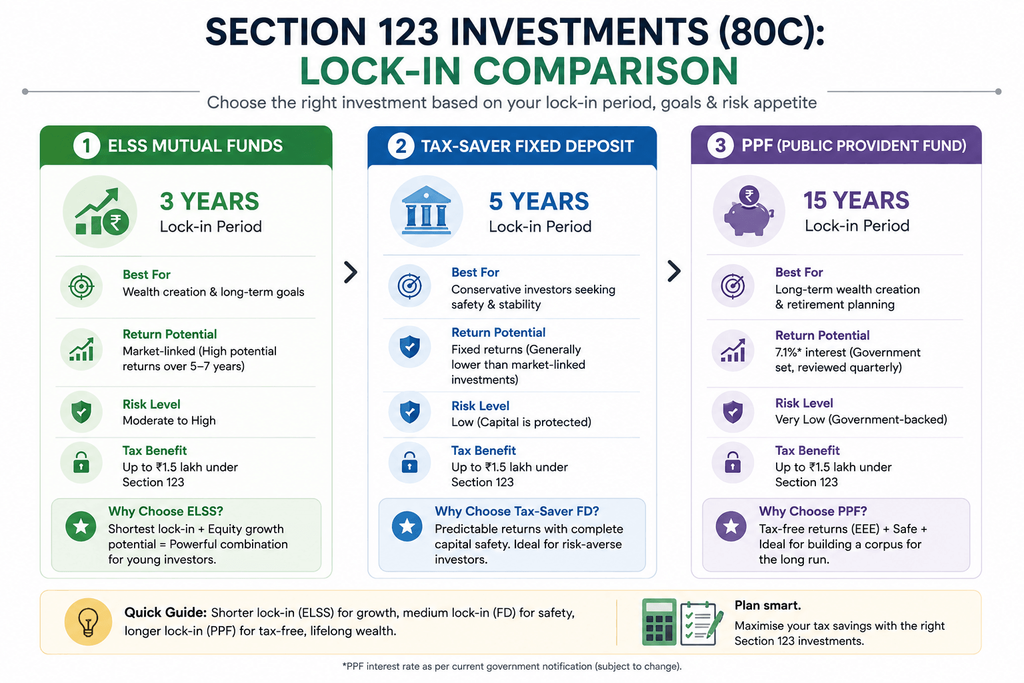
ELSS Mutual Funds The only Section 123 instrument that gives you equity market exposure. Three-year lock-in (shortest among all eligible options), and the returns are market-linked — which means real potential for growth over a 5–7 year horizon, not just tax saving. For younger salaried professionals in the old regime, ELSS is often the most sensible way to fill the remaining ₹1.5 lakh gap. Worth noting: long-term capital gains above ₹1.25 lakh are taxed at 12.5%, so factor that in for larger corpora.
PPF (Public Provident Fund) 15-year lock-in, 7.1% interest (government-set, reviewed quarterly), and completely tax-free at maturity — interest and principal both. The EEE (Exempt-Exempt-Exempt) status makes it one of the most tax-efficient instruments in India for long-term, conservative savers. Not for short-term goals, but genuinely worth holding for retirement planning.
Term Insurance Premium If you have a term plan (and if you’re a salaried earner with dependents, you should), the premium qualifies under Section 123 / Schedule XV. It’s not an “investment” in the returns sense — it’s pure protection — but claiming the premium as a deduction means the cost of protecting your family is partially offset by tax savings under the old regime.
5-Year Tax-Saver Fixed Deposits Safe, predictable, and counts toward the ₹1.5 lakh limit. However, the interest is fully taxable at your slab rate. At the 20–30% bracket, the effective post-tax return may be lower than alternatives. Use these if you want guaranteed capital and have already maxed more efficient options.
What you can skip thinking about for now: ULIP, NSC, Sukanya Samriddhi (unless you have a girl child under 10) — all valid but more specific. Most salaried earners will fill ₹1.5 lakh with EPF + ELSS or PPF alone.
A Practical Starting Point
Before you make any investment decision based on Section 123, do this one thing: find out how much your EPF contribution has already used of your ₹1.5 lakh limit. Your payslip shows the employee PF deduction every month — multiply by 12. That’s your used amount.
Use our free [PPF Calculator] / [ELSS SIP Calculator] to see exactly where you stand
Whatever is left is your actual gap to fill with active investments.
For most salaried professionals in the ₹8–15 lakh range who have chosen the old regime, the gap after EPF is typically ₹60,000–₹1,10,000. An ELSS SIP of ₹5,000–₹9,000 per month fills that cleanly, gives you equity growth, and keeps the deduction organised throughout the year rather than in a last-minute March rush.
If you prefer zero market risk in your tax-saving bucket, a PPF contribution of the same amount works too — just be prepared to commit for the long term.
Two Options Worth Looking At
If you’re ready to start acting on this, two paths are worth exploring depending on your comfort with risk:
For those comfortable with markets, ELSS mutual funds let you invest via SIP, keep the lock-in short at three years, and build real wealth alongside the tax saving. Most major AMCs offer these — you can start a monthly SIP from as low as ₹500.
For those who prefer guaranteed returns alongside a tax deduction, a term insurance plan handles two needs at once: it secures your family’s future and the premium qualifies under Section 123. If you don’t have one yet, it’s the one financial product where delay genuinely has a cost.
Disclosure: Sukoon Money may earn a referral fee if you apply through links on this site. This does not affect what we recommend — we only point to products we’d suggest regardless.
The Short Version
Section 80C isn’t dead. It’s Section 123 now, the ₹1.5 lakh limit is unchanged, and the investments are identical. The only thing that changed is the section number in the law.
What has changed is the context around it: with the new regime offering zero tax up to ₹12.75 lakh for salaried individuals, fewer people need the old regime — and therefore fewer people need to actively fill their 80C bucket.
If you’ve already decided the old regime is right for your situation, your EPF is doing some of the work already. Figure out your gap, pick one or two instruments that match your timeline and risk appetite, and set up a monthly SIP or contribution before March.
That’s all this needs to be.





4 Comments