
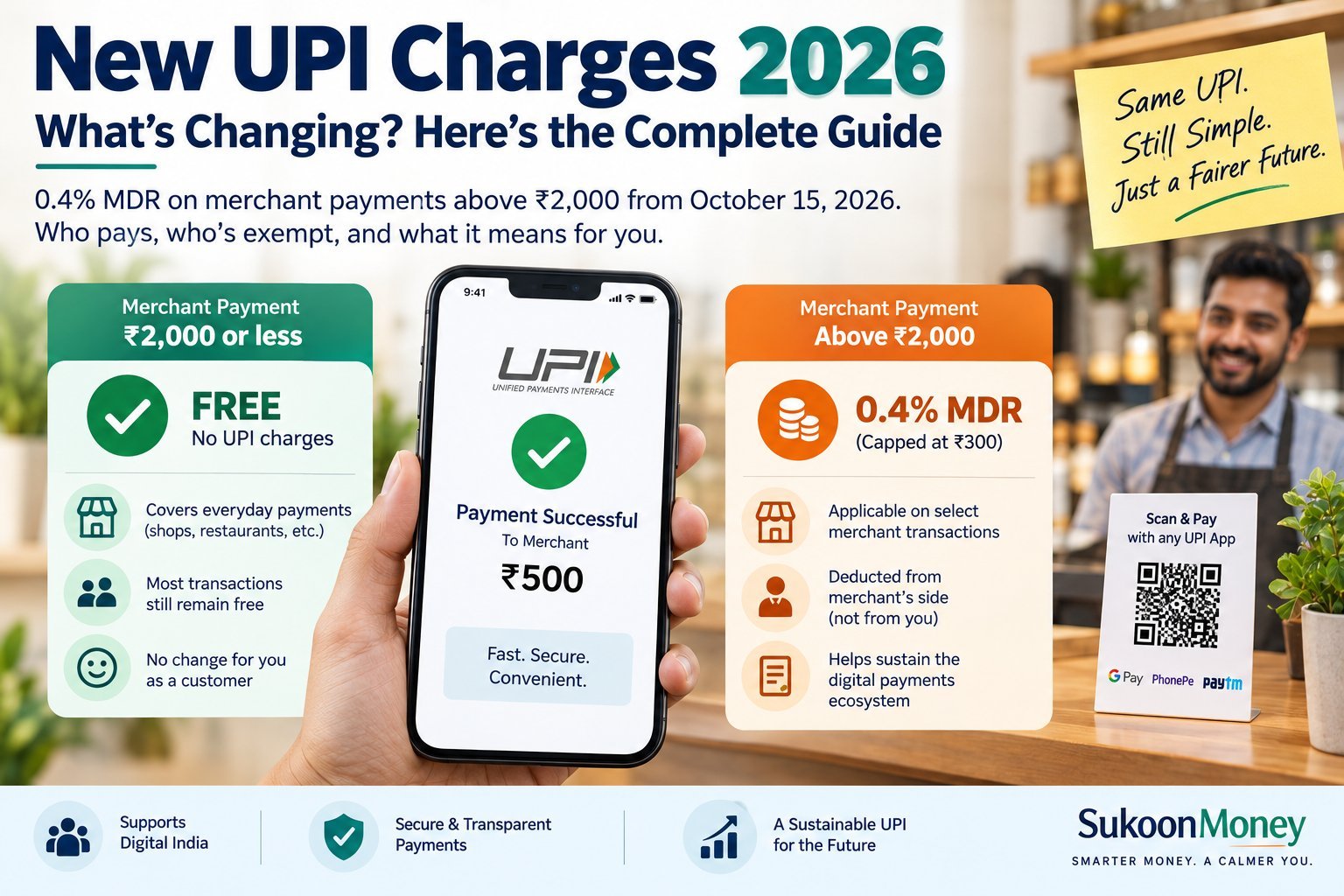
New UPI Charges 2026: Do You Have to Pay Now? Complete MDR Guide
Before we get into the new UPI charges — for six years, UPI has run on a simple promise: it’s free. Free for you sending money to a friend, free for the vegetable vendor accepting your QR code payment, free for practically every transaction that made UPI the backbone of digital India. That’s now changing — but not in the way the panicked headlines are suggesting.
Starting October 15, 2026, new UPI charges will apply to certain merchant transactions under a revised Merchant Discount Rate (MDR) framework announced by NPCI. If you’ve seen alarming posts claiming “UPI is no longer free,” you need the real story — because the truth is far more limited than the panic suggests, but it does matter if you run a business, freelance, or regularly send larger payments to merchants.
Let’s break down exactly what these new UPI charges mean for every UPI user, who actually pays them, and what stays completely free.
Table of Contents
What Are the New UPI Charges in 2026?
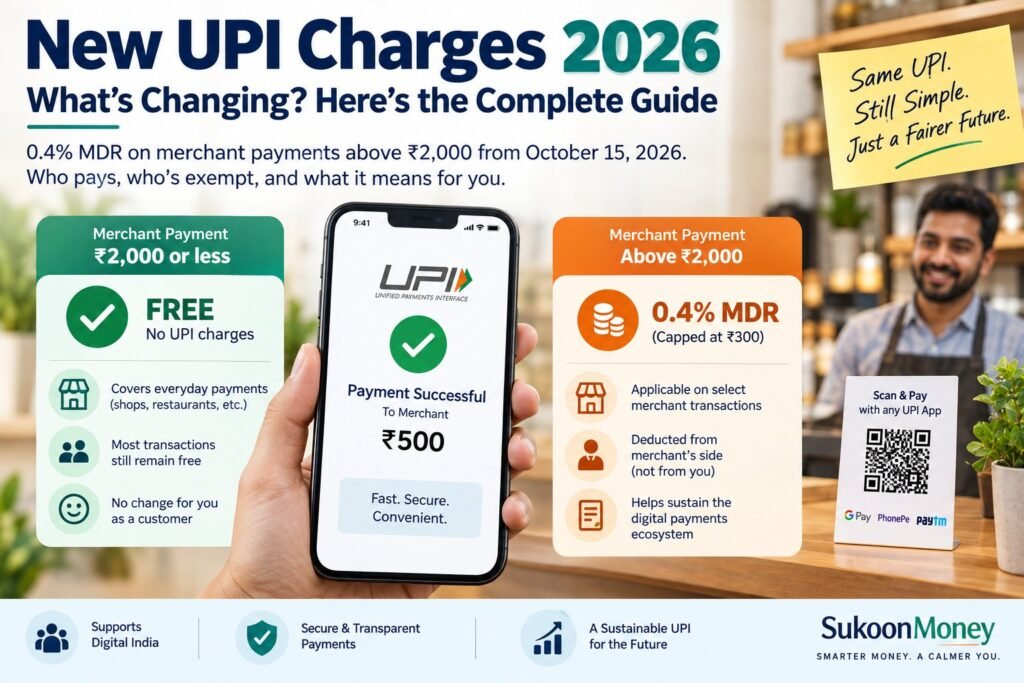
The new UPI charges for 2026 introduce a 0.4% Merchant Discount Rate (MDR) on select Person-to-Merchant (P2M) UPI transactions above ₹2,000, effective October 15, 2026. This UPI MDR is capped at ₹300 for transactions of ₹75,000 and above.
Critically, these UPI charges apply only on the merchant side of specific transactions — not to ordinary consumers making payments. NPCI has been explicit: this is not a fee you pay when scanning a QR code or sending money.
Why Is NPCI Introducing UPI Charges Now?
For context: in 2020, the Indian government waived MDR charges entirely on UPI to accelerate digital payment adoption. That zero-MDR policy has held for six years — so much so that in June 2025, the Finance Ministry publicly and firmly denied rumours of any UPI charges being planned, calling such claims “baseless and misleading.”
So why introduce new UPI charges now? The core reason cited is sustainability of the digital payments ecosystem. UPI now processes roughly 24.5 billion transactions worth ₹29.82 trillion in a single month (August 2026 alone). Running this infrastructure — servers, fraud monitoring, dispute resolution, banking integration — costs money, and banks and payment aggregators have long argued that a completely free system isn’t commercially sustainable at this scale.
Alongside the new UPI charges, the government has also announced a fund to provide financial assistance and incentives to acquiring banks and payment aggregators — aimed at encouraging merchant onboarding and continued small-business participation in UPI, even as some transactions now attract a fee.
Full Breakdown — Who Pays the New UPI Charges and Who Doesn’t
This is the part about the new UPI charges that matters most, so let’s be precise.
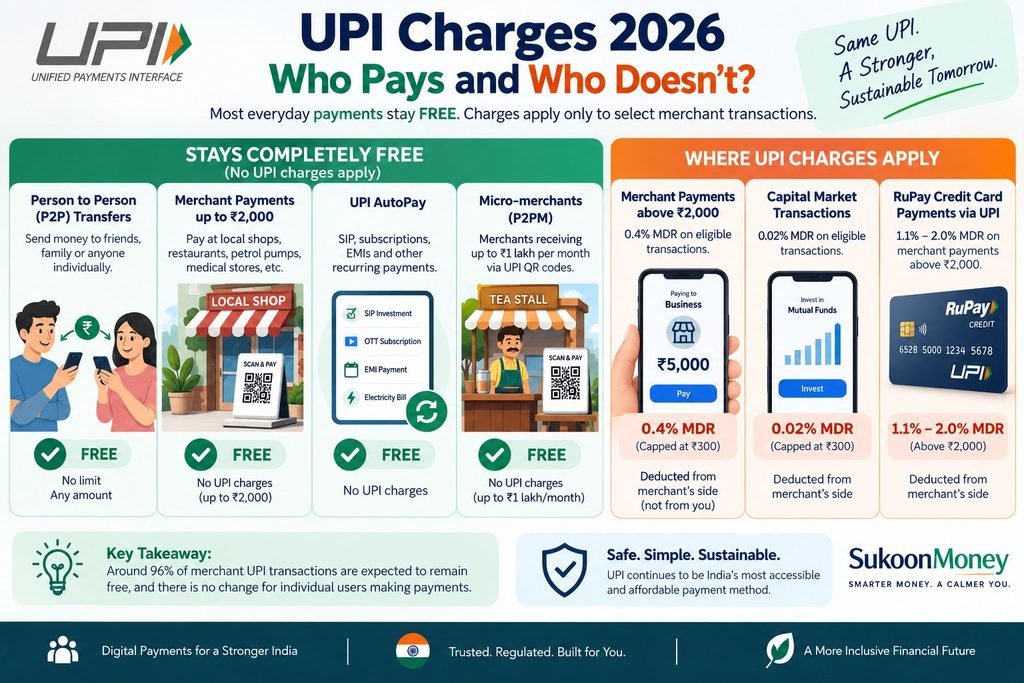
Stays completely FREE — no UPI charges apply:
- All Person-to-Person (P2P) transfers — sending money to friends, family, or anyone individually, regardless of amount
- Person-to-Merchant (P2M) transactions up to ₹2,000 — this covers the overwhelming majority of daily UPI use: street vendors, tea stalls, small grocery purchases, auto-rickshaw payments
- UPI AutoPay — recurring payments like SIP mandates, subscription payments, and EMI auto-debits remain untouched by the new UPI charges
- Micro-merchants (P2PM category) — merchants receiving up to ₹1 lakh per month via UPI QR codes are exempt from these UPI charges, protecting small kirana stores and roadside vendors
- Scanning QR codes at local shops — regardless of transaction value, if the merchant qualifies under the P2PM exemption
Where the new UPI charges DO apply:
- Person-to-Merchant transactions above ₹2,000 — a standard 0.4% MDR applies here. On a ₹3,000 payment, that’s ₹12 — but this is deducted from the merchant’s side, not added to what you pay
- Capital market transactions — eligible transactions attract a lower MDR of 0.02%, capped at ₹300
- RuPay credit card payments via UPI — these carry a separate, higher MDR of 1.1% to 2.0% for merchant payments exceeding ₹2,000
The government’s own estimate: around 96% of merchant UPI transactions will remain completely unaffected by these new UPI charges, since most everyday purchases fall under ₹2,000 or involve exempt micro-merchants.
Real Numbers — What the UPI Charges Actually Cost
Understanding the actual rupee impact of the new UPI charges helps cut through the confusion:
As the table shows, you as a consumer will never see a separate line-item UPI charge on your bank statement — the MDR is absorbed entirely within the merchant payment ecosystem, similar to how card payment processing fees have always worked.
How This Affects Small Businesses and Freelancers
If you run a small business, freelance, or invoice clients through UPI, these new UPI charges deserve your attention — even if they don’t touch your personal payments.
What to actually check:
- Are you under the ₹1 lakh/month P2PM exemption threshold? If so, you’re unaffected regardless of individual transaction size
- Do you regularly receive single payments above ₹2,000 from clients or customers? A 0.4% cost may now factor into your effective margin
- Are your customers paying via RuPay credit card on UPI? These carry a notably higher MDR (1.1-2%) that’s worth being aware of if a large share of your business comes through that channel
For most small shopkeepers processing routine daily transactions, the impact of these UPI charges will likely be minimal or zero. For businesses regularly processing higher-ticket transactions — consultants, service providers, larger retailers — it’s worth factoring the 0.4% into pricing conversations going forward.
UPI Charges vs UPI Privacy Rules — Two Separate 2026 Changes
It’s easy to conflate this with another major UPI update this year. To be clear, these are two entirely separate changes:
- UPI Privacy Rules (effective September 4, 2026) — masks your mobile number, UPI ID, and account number during transactions for privacy protection. No cost involved.
- UPI Charges / MDR (effective October 15, 2026) — introduces a merchant-side fee on select transactions above ₹2,000. No privacy implications.
Both changes are part of NPCI’s broader 2026 overhaul of the UPI ecosystem, but they address completely different concerns — one is about data privacy, the other about payment infrastructure economics.
Timeline of the New UPI Charges
Timeline of the New UPI Charges
How India moved from zero MDR to the 2026 UPI charges framework
This reversal within roughly a year of the Finance Ministry’s denial reflects how quickly the scale and cost pressures of UPI’s growth have evolved.
Running a small business and wondering how these UPI charges might affect your specific setup? Drop your question in the comments.
Also read: