

EPFO Wage Ceiling Hiked to ₹25,000 — What Changes for Your PF, Pension and Take-Home Pay
If you’re a salaried employee in India, here’s something that just changed — quietly, quickly, and with very little fanfare — that directly affects how much lands in your EPF account, what your pension might look like, and in some cases, what hits your bank account every month.
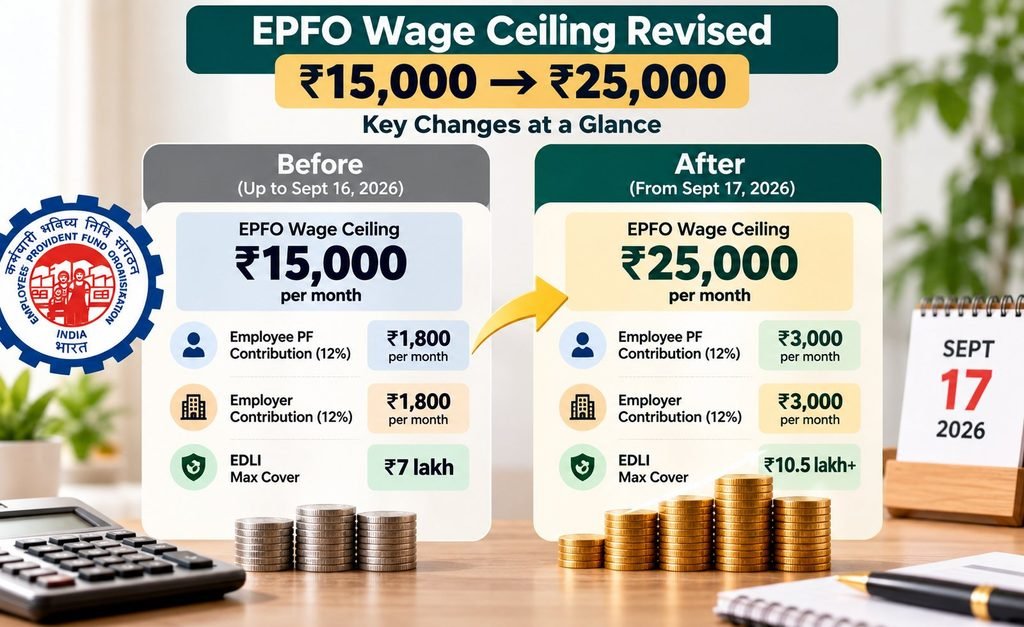
The EPFO wage ceiling has been revised from ₹15,000 to ₹25,000 per month, effective September 17, 2026. The Union Cabinet approved the change on September 16, and the Ministry of Labour and Employment issued the formal Gazette Notification (S.O. 5109(E)) the very next day.
It’s the first revision of the EPFO wage ceiling in 12 years — the last time it moved was September 2014, when it went from ₹6,500 to ₹15,000. And depending on where your salary sits, this change could mean more retirement savings, a higher future pension, better life insurance cover — or simply a slightly smaller take-home every month.
Let’s break down exactly what the new EPFO wage ceiling means for you.

Table of Contents
What Is the EPFO Wage Ceiling — and Why Does the New Limit Matter?
The EPFO wage ceiling is the maximum monthly wage on which mandatory EPF contributions are calculated. It determines who must be covered under EPFO and sets the base for calculating contributions to three schemes:
- EPF (Employees’ Provident Fund) — your long-term retirement savings
- EPS (Employees’ Pension Scheme) — your future monthly pension
- EDLI (Employees’ Deposit Linked Insurance) — life insurance cover for your family if you die while in service
Before September 17, 2026, the EPFO wage ceiling was ₹15,000. This meant that if your basic salary was above ₹15,000, you were not mandatorily required to be under EPFO — though you could opt in voluntarily. And if you were already a member, contributions were only calculated up to ₹15,000, not your actual higher salary (unless your employer had agreed to contribute on the full actual salary).
The new EPFO wage ceiling of ₹25,000 changes that calculus for a large number of workers.
Who Does the Revised EPFO Wage Ceiling of ₹25,000 Affect?
The impact of the revised EPFO wage ceiling depends on where your salary currently sits.
If your basic salary is ₹25,000 or more: You were already either voluntarily contributing on your full salary or contributing only on the capped ₹15,000 base. If your employer was already contributing on the full actual salary, this revision doesn’t change much day-to-day for you. If contributions were capped at the old ₹15,000 ceiling and you weren’t opted in for higher voluntary contributions, your base for mandatory contributions now moves up to ₹25,000.
If your basic salary is between ₹15,001 and ₹25,000: This is where the most significant change happens. You were previously in a grey zone — either excluded from mandatory EPFO coverage entirely or contributing on a capped base. Under the new EPFO wage ceiling, you are now mandatorily brought under the EPFO wage ceiling framework — covering EPF, EPS, and EDLI. This is the group the government estimates at over 51 lakh additional employees across India.
If your basic salary is ₹15,000 or below: You were already under mandatory coverage. The revised ceiling doesn’t change your contribution calculation — your 12% continues to apply to your actual salary.
Real Numbers — What Changes in Your Monthly Salary
Let’s put actual rupees to this revised EPFO wage ceiling. EPF contributions are calculated at 12% of basic wages from both the employee and the employer.
For employees at the new ₹25,000 ceiling:
- Monthly EPF deduction goes from ₹1,800 to ₹3,000 — that’s ₹1,200 more per month out of your take-home
- Annual EPF corpus addition goes from ₹43,200 to ₹72,000 — a significant jump in long-term savings
Important caveat on take-home salary: If your employer’s PF contribution is part of your CTC structure, the higher employer contribution will reduce your net take-home pay — because the same CTC now gets split differently. If your PF is structured as a benefit over and above your CTC, your take-home stays the same and it’s just a higher employer cost.
How the New Ceiling Affects Your EPS Pension
The EPS pension change is something most people are not thinking about — but it’s one of the most meaningful parts of this revision.
EPS pension depends on factors including pensionable salary and eligible pensionable service. Members generally need at least 10 years of eligible service to qualify for monthly pension. The formula for EPS pension is:
Monthly Pension = (Pensionable Salary × Pensionable Service) ÷ 70
With the old ₹15,000 ceiling, your pensionable salary was capped at ₹15,000 regardless of your actual salary. With the new ₹25,000 EPFO wage ceiling, your pensionable salary cap moves up to ₹25,000.
Example:
- 25 years of pensionable service
- Old ceiling: (₹15,000 × 25) ÷ 70 = ₹5,357/month
- New ceiling: (₹25,000 × 25) ÷ 70 = ₹8,928/month
That’s a ₹3,571 increase in monthly pension — for the same years of service, just a higher pensionable salary base.
One important note: employees who joined service after September 1, 2014, with a basic salary exceeding the previous threshold remain excluded from EPS membership. So if you joined after September 2014 with a basic salary above ₹15,000 and were never enrolled in EPS, you don’t automatically get enrolled now — speak to your HR to confirm your EPS membership status.
EDLI Life Insurance Cover Also Goes Up
The third — and most overlooked — impact of the new EPFO wage ceiling is on your EDLI insurance cover.
EDLI provides your family a lump-sum death benefit if you die while in active EPFO service. The benefit is calculated as:
EDLI Benefit = 35 × Average Monthly Wage (last 12 months) + 50% of Average EPF Balance, up to ₹1.75 lakh
Under the old ₹15,000 EPFO wage ceiling, the maximum EDLI benefit worked out to approximately ₹7 lakh (35 × ₹15,000 + ₹1.75 lakh).
Under the Employees’ Deposit Linked Insurance (EDLI) scheme, maximum family insurance coverage upon an active member’s death increases from ₹7 lakh to ₹10.50 lakh or more due to the revised ₹25,000 ceiling.
This is essentially free life insurance bundled with EPFO membership under the revised EPFO wage ceiling — and the cover just went up by 50%.
What About September 2026 — A Split Month?
Here’s a very practical question many employees and HR teams are asking about the new EPFO wage ceiling: since it kicked in on September 17 (not September 1), does September get split into two contribution periods?
No.
From October onwards, the revised wage ceiling of ₹25,000 per month will apply for the full wage month. EPFO has communicated to employers that there is no need to split September 2026 wages into two periods. Contributions for the entire month of September 2026 are to be remitted at the revised ₹25,000 ceiling — as confirmed by the Gazette notification and subsequent EPFO employer communications.
The ECR (Electronic Challan cum Return) for September 2026, due by October 15, 2026, should reflect the new ₹25,000 ceiling for the full month.
Does the New EPFO Wage Ceiling Affect People Already Contributing on Higher Wages?
Many employers — especially larger companies — have been voluntarily contributing on their employees’ actual salary (above ₹15,000) all along, with employee consent.Many employers and employees, with their joint consent, have already been contributing on their actual higher salary, and they wouldn’t be impacted due to the recent change in wage ceiling.
If you’re in this group, the new EPFO wage ceiling is largely a formalisation of what was already happening. Your contributions stay on actual salary, and the EPFO wage ceiling change doesn’t alter your day-to-day calculation.
Also read:




One Comment