
Old vs New Tax Regime: Which Is Better for Salaried Indians? (A Simple 2026 Guide)
Deciding between the old vs new tax regime is a choice that causes a quiet panic for salaried individuals every year around declaration time. Everyone has an opinion, none of them agree, and the wrong choice can cost you thousands. If you’ve been putting off this decision because it feels complicated, take a breath — choosing between the old vs new tax regime for salaried people comes down to one simple idea, and once you see it, the whole thing gets easy.
Table of Contents
Let me walk you through it the calm way, in plain English, with the actual numbers.
Why this question suddenly matters more
Here’s what changed and why everyone’s confused: the new tax regime is now the default. If you do nothing, you’re automatically taxed under it. That’s a big shift from the old days, when the old regime was the standard.
The result? A lot of salaried people are ending up in the new regime without ever consciously choosing it — and some of them are paying more tax than they need to, while others are needlessly clinging to the old regime out of habit. The good news: as a salaried person with no business income, you can choose freshly every single year when you file your return. You’re never locked in. You just have to choose well.
The one idea that decides everything: deductions
Strip away all the jargon and the entire decision rests on a single question:
How much do you claim in deductions?
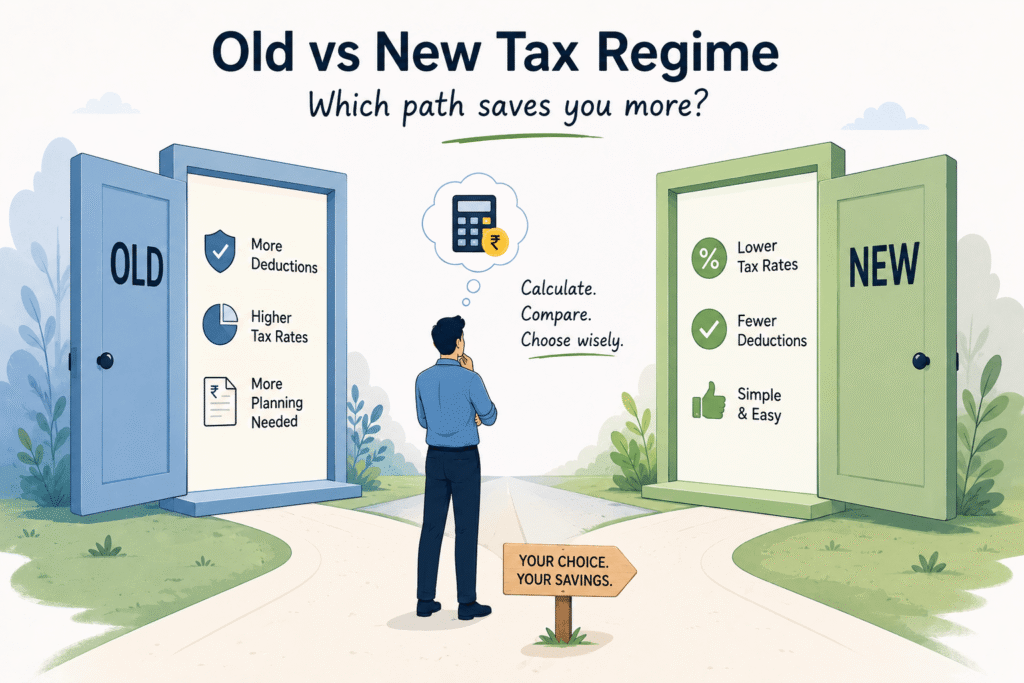
- The new regime gives you lower tax rates, but takes away almost all the deductions and exemptions.
- The old regime keeps all the familiar deductions — 80C, HRA, home loan interest, health insurance — but charges higher tax rates.
So it’s a trade: lower rates with no deductions, versus higher rates with lots of deductions. Whichever saves you more depends entirely on how much you’d actually claim. This is called the “break-even point,” and it’s the whole game.
The new regime, in plain English
The new regime is built for simplicity. Lower rates, a standard deduction of ₹75,000 for salaried people, and one headline feature that matters enormously: income up to ₹12 lakh is effectively tax-free thanks to the Section 87A rebate. For a salaried person, adding the standard deduction, that means earnings up to around ₹12.75 lakh can attract zero income tax.
The slabs (for FY 2026-27) run like this: nothing up to ₹4 lakh, then 5% from ₹4–8 lakh, 10% from ₹8–12 lakh, 15% from ₹12–16 lakh, 20% from ₹16–20 lakh, 25% from ₹20–24 lakh, and 30% above ₹24 lakh.
The catch: you can’t reduce this with your PPF, insurance, or HRA. What you see is what you pay.
The old regime, in plain English
The old regime rewards people who invest and claim. Its rates are higher, but you can shrink your taxable income with a whole toolkit of deductions:
- Section 80C (up to ₹1.5 lakh): PPF, EPF, ELSS mutual funds, life insurance premiums, tax-saving fixed deposits, and more.
- Section 80D: health insurance premiums.
- HRA: house rent allowance, if you pay rent.
- Home loan interest under Section 24(b).
If you genuinely use all of these, they add up fast — and can pull your taxable income down enough that the higher rates still work out cheaper.
If you’ve decided the old regime works for you, the next question is how to use your Section 80C / Section 123 allowance wisely. [Here’s our guide to the best 80C investments in 2026.]
So which one are you? A simple decision guide
Here’s the honest rule of thumb, verified against current figures:
The new regime wins for most salaried people with modest deductions — if you don’t invest much beyond your EPF, don’t pay rent, and have no home loan, the new regime almost always costs you less.
The old regime wins only when your total genuine deductions are large — roughly ₹4.5 lakh to ₹8 lakh or more, depending on your income. That usually means a serious combination: full 80C, health insurance, meaningful HRA, and a home loan.
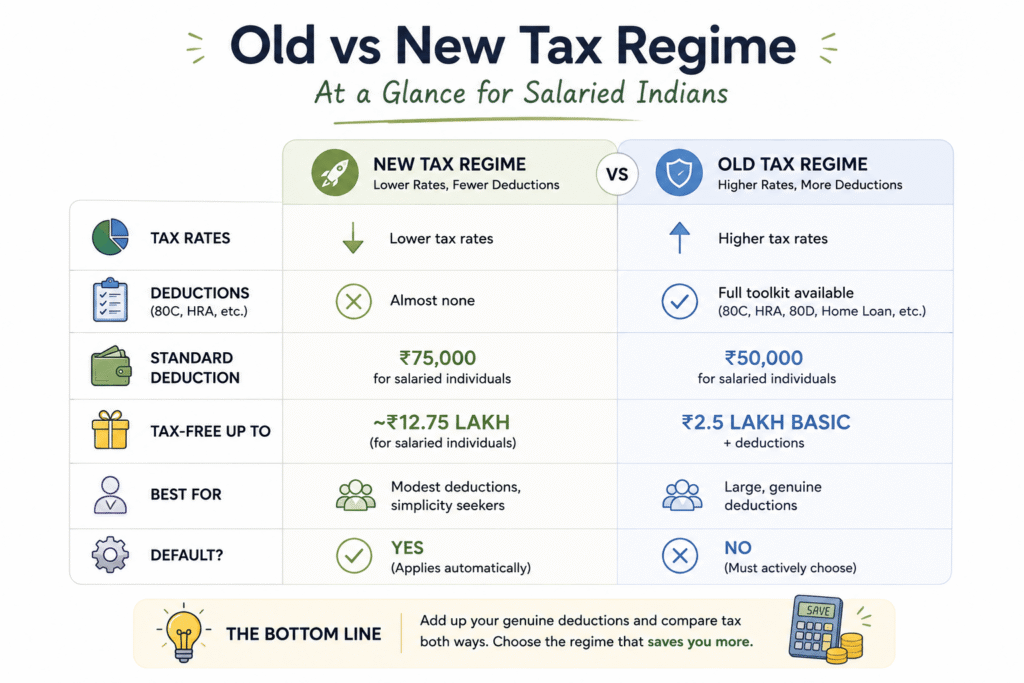
| New Regime | Old Regime | |
|---|---|---|
| Tax rates | Lower | Higher |
| Deductions (80C, HRA, etc.) | Almost none | Full toolkit |
| Standard deduction | ₹75,000 | ₹50,000 |
| Tax-free up to | ~₹12.75 lakh (salaried) | ₹2.5 lakh basic + deductions |
| Best for | Modest deductions, simplicity | Large, genuine deductions |
| Default? | Yes | No — must actively choose |
(For latest rates please refer to the Income Tax website)
The only way to be certain is to compute your tax both ways — an online tax calculator does this in seconds, and it’s worth the five minutes. Don’t guess; check.
4 Mistakes to Avoid in the Old vs New Tax Regime
A few traps catch salaried people every year:
- Don’t let tax-saving drive bad decisions. This is the big one. The old regime tempts people into buying insurance policies or locking money into investments they don’t actually need, purely to claim a deduction. Saving ₹30,000 in tax by spending ₹1.5 lakh on a policy you didn’t want is not a win. Invest because it’s right for you, not just for the deduction.
- Don’t miss the filing deadline. A late return can quietly lock you into the new regime by default — so if the old regime saves you money, filing on time is what protects that choice.
- Don’t just copy last year. Your income, rent, and investments change. Re-check every year, because the better regime can flip.
- Don’t choose on rates alone. A lower rate doesn’t automatically mean lower tax. It’s always the final rupee figure that counts.
What to actually do this year
Keep it simple:
- Add up your genuine deductions — the ones you’d claim anyway, not ones you’d invent to save tax.
- Put your income and those deductions into an online old-vs-new tax calculator.
- Whichever shows the lower final tax, that’s your regime for the year.
- If it’s the old regime, remember to actively select it when you file — and file on time.
That’s it. No spreadsheets, no stress — just one honest calculation, once a year.
The tax regime you pick is really just one piece of handling your money with calm and clarity. If you want to see how it fits the bigger picture, read our companion guide, Financial Freedom for Salaried Indians: A Step-by-Step Roadmap, which lays out the full, step-by-step path from a steady salary to real financial freedom.
A note on figures: the slabs, limits, and break-even ranges above reflect FY 2026-27. Tax rules can change with each Union Budget, so treat this as a guide and confirm the latest numbers (or use a current calculator) before you file.
See exactly where you stand
Everything above shows you the shape of the decision — but your own income and deductions are what actually settle it. No need to do the arithmetic by hand.
Enter your salary and deductions into our free Old vs New Tax Regime Calculator, and it instantly shows your tax under both regimes side by side, plus which one saves you more.
Try the Old vs New Tax Regime Calculator →
Also Read:
EPF Form 15G in 2026: It’s Been Replaced to Form 121— Here’s Everything You Need to Know





7 Comments